Mount Meru comes up often in the teachings I translate, including teachings that have very little to do with cosmology as their main subject. A reference to the four continents, an explanation of rebirth in a particular heaven, a few words about the mandala offering, and suddenly some familiarity with the whole arrangement is required.
Usually, we know a few names. We may remember a drawing. But following an explanation through the desire, form, and formless realms requires a little more than recognising the terminology. The same is true when reciting the mandala offering: we can become quite proficient at naming things without having a particularly clear idea of what we have just offered.
I wanted a model I could move around, with explanations attached to the things being described. Something to have open beside a text or return to after a teaching. This became World System.
I should first say that I do not subscribe to the notion that Abhidharma cosmology is an outdated, medieval description of the universe which we ought to "update." I find this attitude rather presumptuous. Mountains, continents, distances, and heavenly bodies appear in the text, so we assume that its authors were attempting the same kind of account we now expect from physical cosmology, only with less information at their disposal.
The Abhidharma presentation goes beyond the simplistic opposition between a subjective experience "in here" and an objective world "out there." It concerns beings, their faculties, their karma, and the worlds they experience. The perceiver is very much part of what is being examined. There is no good reason to remove this part of the account and then assess whatever remains as an unsuccessful attempt at geography. The expectation of a so-called "objective" description is itself a peculiarly human, peculiarly Jambudvīpa way of viewing things. We take the conditions of our own perception for granted and use them to judge every other kind of experience, even though, within the teachings, human experience on this continent occupies a small portion of what is possible.
Calling everything "subjective" does not help much either. We are still working within the same dichotomy. I would prefer to understand the presentation on its own terms before deciding that it needs renovation.
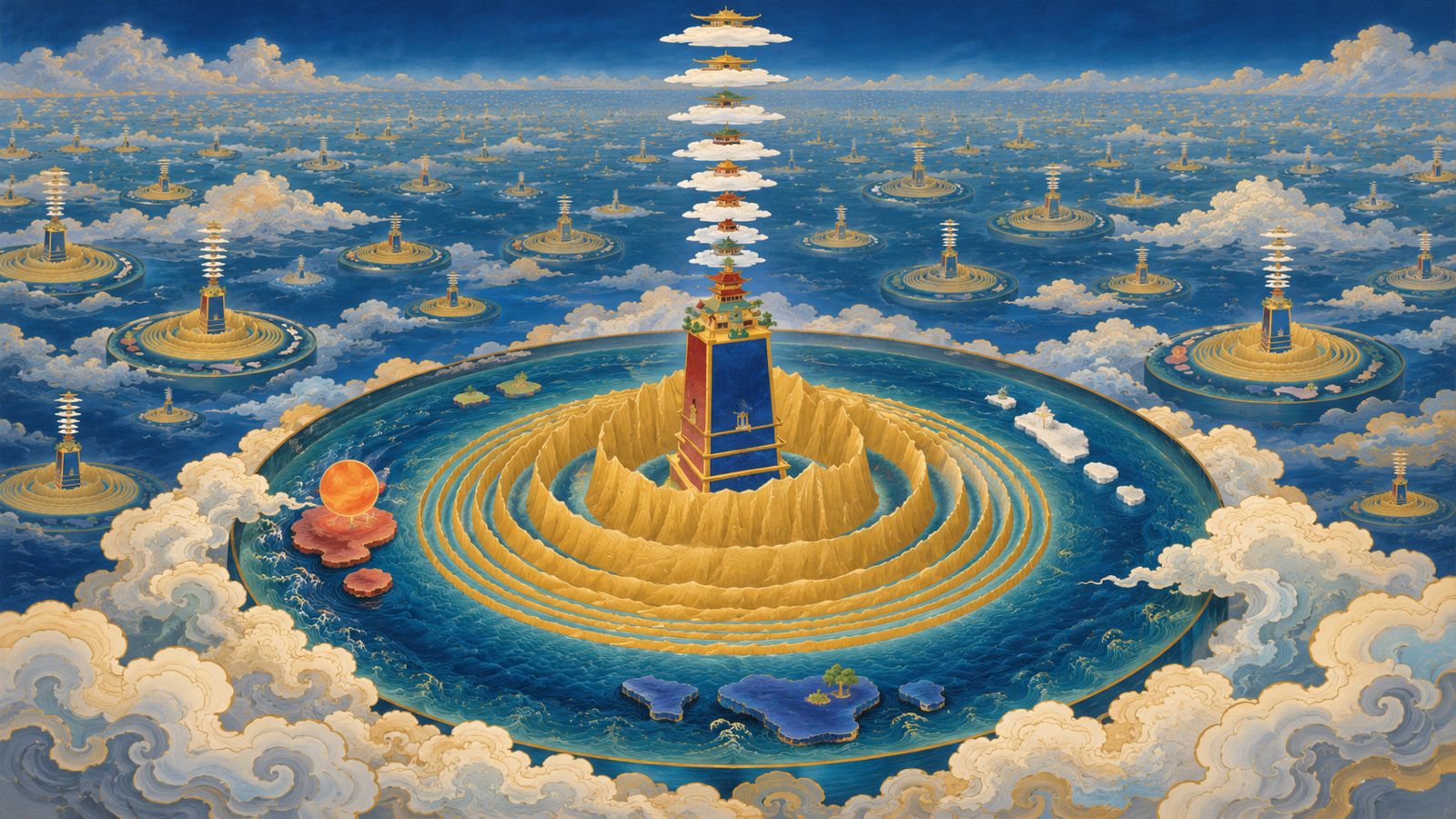
The model is grounded principally in Vasubandhu's Abhidharmakośa, especially chapter III, and Jamgön Kongtrul's Myriad Worlds. Meru stands at the centre, surrounded by the seven golden ranges and their intervening seas, with the continents farther out. The realms can be explored individually. Selecting a feature opens its explanation, including the Sanskrit and Tibetan names and the relevant descriptions from the sources.
The ability to turn the model is useful in itself. After looking for a continent, approaching it, and turning back towards Meru, I remember the arrangement a little differently. This helps the map settle somewhere beyond the part of my memory occupied by lists of Tibetan terms.
The drawing does make concessions to visibility. Some dimensions have been altered so that smaller features can be seen, and these changes are explained in the app. Likewise, a visible representation of a formless absorption is obviously a convention.
The mandala offering was one of the main reasons for making the model. Meru and its golden mountain ranges often serve as a representation of all the wealth and splendour of humans and gods. The continents, their treasures, the possessions of a universal monarch, the offerings of the goddesses: there is a considerable amount being gathered onto that plate.
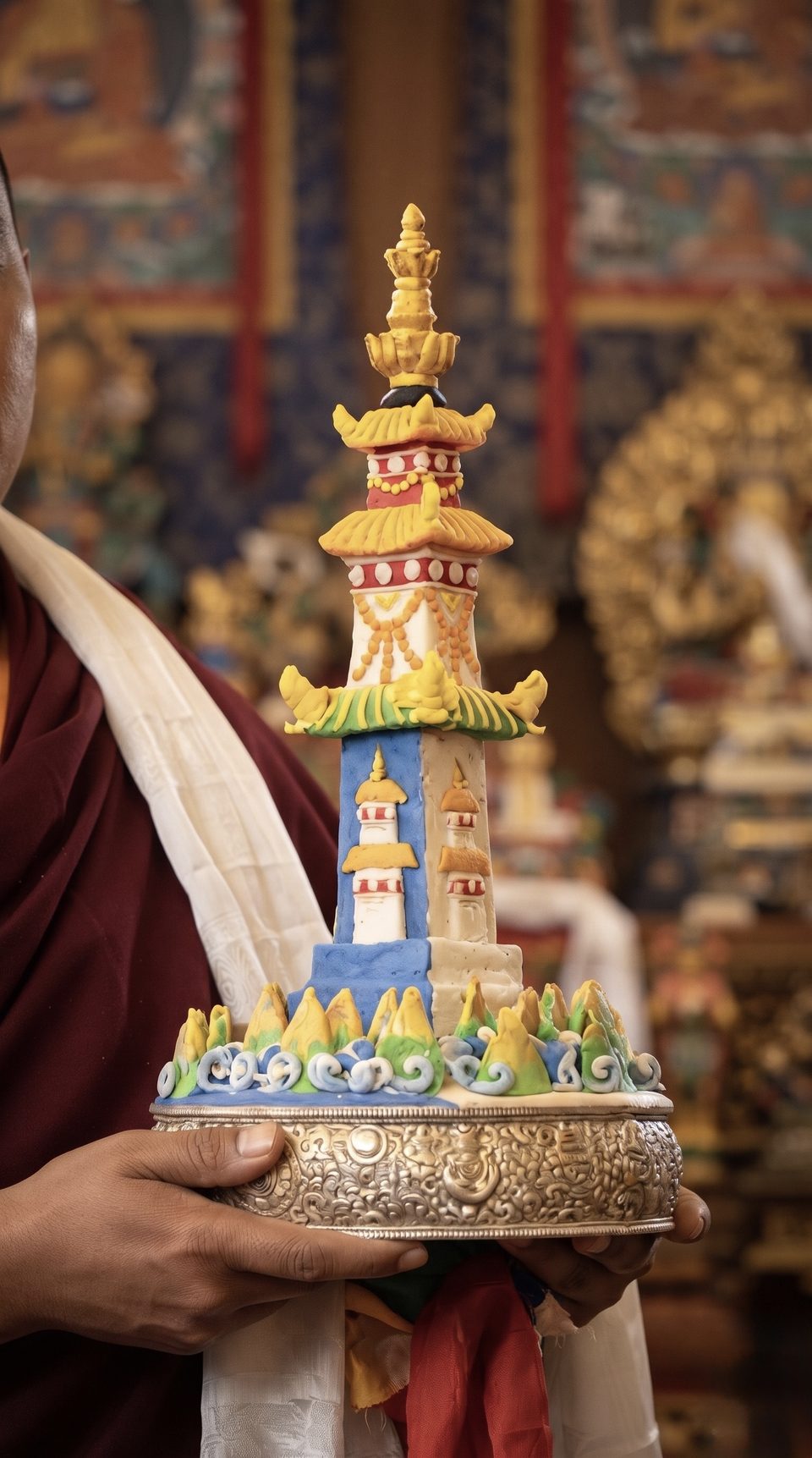
It is easy to recite "all the wealth of humans and gods" while imagining something meagre. Our own sense of wealth is limited enough. The offering asks us to become acquainted with a far larger account of what beings possess, enjoy, and hold precious, and then offer the whole of it.
The app includes the thirty-seven-point offering, following Lama Sonam's diagram for its placement. You can follow the sequence or take an untimed tour, stopping at each offering to read its explanation. This is useful when learning the arrangement, especially if the recitation has become familiar faster than the visualisation. The details of the physical offering and its orientation should follow your practice instructions.
The wheel of life is included as a painted relief. Its individual parts can be selected: the poisons at the centre, the courses of karma, the six realms, and the twelve links of dependent origination. We have all seen this image often enough to recognise it immediately, and probably not often enough to say what each part is doing.
Then there is the Game of Rebirth, traditionally attributed to Sakya Paṇḍita, which will look familiar to anyone who has played Snakes and Ladders. It can be entertaining. A throw takes you somewhere promising, leaves you waiting, or places you in a condition from which departure becomes a tedious business.
The board contains 104 squares. The die determines a destination according to the square you occupy, rather than telling you how many spaces to advance. Some throws accomplish nothing. Certain traps require particular repeated throws before you can leave. Cruel world mechanics!
Every square has an explanation. You can play quickly and merely glance at the worlds you pass through, or stop and read the full entry for each. The latter turns the game into a proper course of study. It introduces possibilities of rebirth, forms of perception, pleasures, sufferings, and lifespans that are difficult to fathom from our present circumstances.
The path is not a score. As in Snakes and Ladders, you can fall after what looked like good progress, and a favourable rebirth is still a rebirth. Square 104 represents nirvāṇa, and the difference between liberation and arriving somewhere pleasant is essential to understanding the board. The app gives this difference a spatial expression as well, although the placement of the path and its result is a visual interpretation, not an altitude chart of spiritual accomplishment.
If the game conveys one thing, it is that saṃsāra is vast. There is a mind-boggling amount of room in which to continue wandering, and some of its conditions seem very attractive indeed.
How vast, exactly? As a translator, I have a few obsessions. Some concern mistranslations of commonly used terms, a favourite topic among translation nerds. One persistent rendering gives me a particular sense of dissatisfaction (is that you, dukkha?) because it diminishes the sheer scale of what is being described: stong gsum as "three-thousandfold universe." Read cold, three thousand is a reasonable guess. It is also off by a factor of about 333,000, because the three refers to three successive orders of a thousand: 1,000 × 1,000 × 1,000, a billion worlds. An arrangement like the one we have just been examining (Meru, the four continents, the subcontinents, and so forth) times a thousand, times a thousand, TIMES A THOUSAND. In this cosmological presentation, that is the domain of activity of an individual Buddha, such as our own Guide, Buddha Śākyamuni: a billion worlds within the field of his inconceivable activity.
The Billion Worlds mode is my attempt to make this arithmetic visible. It starts with one world system and expands through those three orders. The Meru that filled the screen becomes one among a thousand, then increasingly difficult to locate. At least here, you have to spend a moment with what the numbers mean.
This offers some impression of the scale involved in descriptions of Sahā, "Endurance", our world system. Sahā itself belongs within a much larger presentation of worlds and buddhafields. Such almost incomprehensible scale is a familiar feature of Mahāyāna Buddhism, although it is easy to read past it. We understand that a passage means "very many," and continue.
These worlds also burn, drown, or are scattered by wind, and the app includes a brief presentation of all three. In a cycle ending in fire, successive suns appear until there are seven. Rivers, lakes, and oceans dry up, and Meru and the lower worlds burn. Other cycles end in water or wind, reaching progressively higher levels of the form realm. These are separate cycles within the recurring sequence described in the texts.
Formation, abiding, destruction, and a period of emptiness are followed by formation again. Kongtrul presents the account in Myriad Worlds. It seemed appropriate to include this after putting so much work into making the mountains look substantial.
The astrology layer is still being expanded. At present, it is a cursory glance into a much larger subject, including the lunar mansions and material from the White Beryl. Treat it as an introduction.
Like the other apps on my site, World System began with something I wanted available during translation and study. I hope it will also be useful to people following teachings, learning the mandala offering, or trying to make sense of a cosmological reference that has appeared for the fifth time without becoming any clearer.
It is a study aid. It does not replace reading transmission (lung), empowerment (wang) where required, or practice under the guidance of a lama.
World System is available here. It is free and works offline once the initial download has finished, so open it while connected and give it a moment. Adding it to your home screen keeps it handy for the next time a billion worlds are mentioned in passing.