A view from some-where.
01/07/2026, 04:27
“There is something ineffable about the meeting of the angles of the wall in the corner of your room. There is a circling beauty and symmetry. The evenness and the unevenness—graceful and distinct. The angles themselves present a mystery I could never solve.
When you look at a straight line rising from the floor to the ceiling, it is—for a while—convex, and then concave. The convex becomes concave, inexplicably. The sensation is exquisite. You notice the way the shading of the walls meets the angles and propagates unevenly, depending on the light. Every crook of the wall is an infinitude of shades that, if one’s senses were fully open, could overwhelm in an instant.
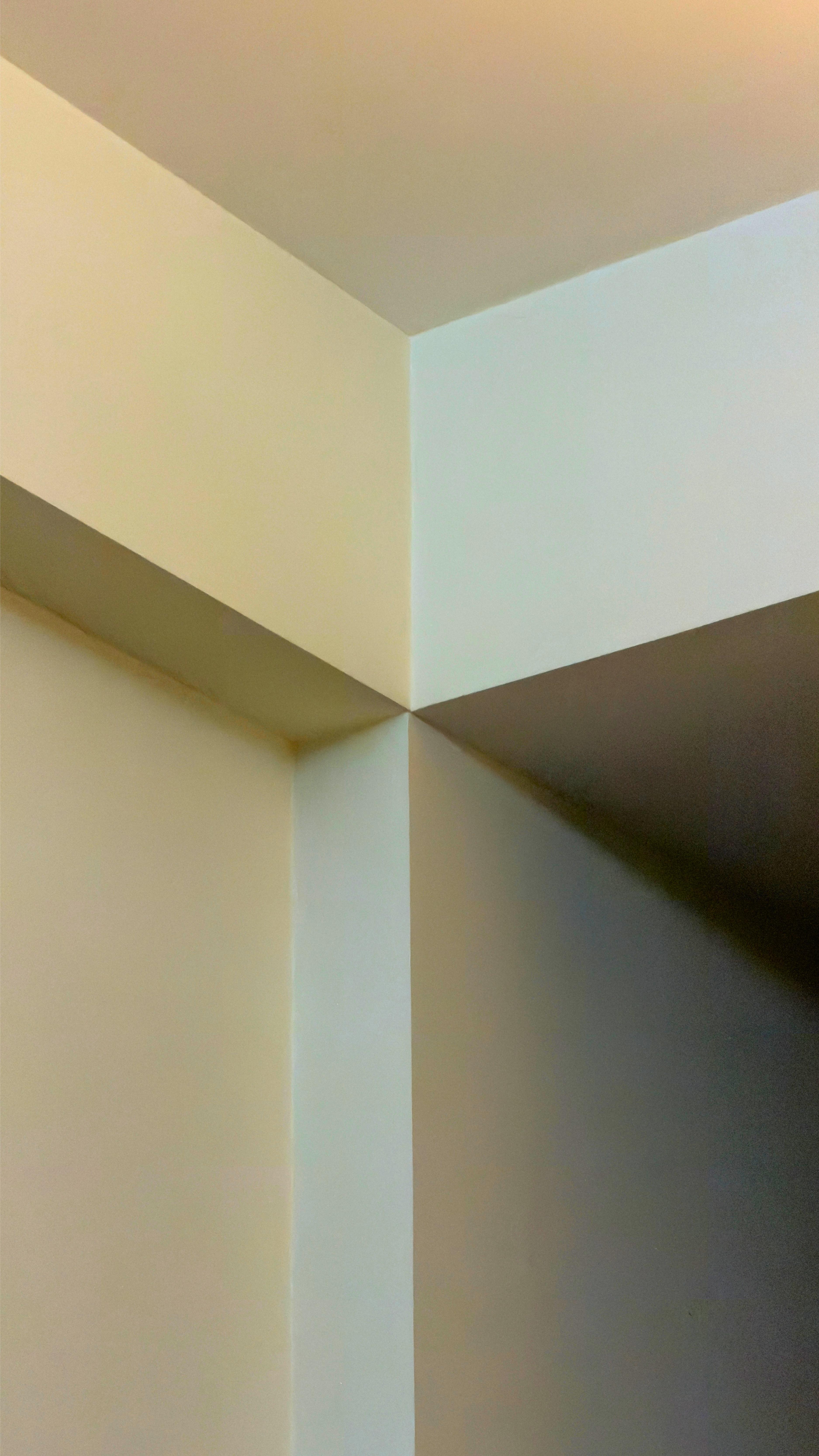
The meeting of six different angles seems to communicate something impossible to understand. And this is before even opening the question of how one directly interfaces with such a phenomenon. The lived experience is far from the theoretical scheme I’ve described. A magical display like this is unpredictable. If your eyes dart right or left, then return, the subject has changed. Afterimages linger in the visual field. Phosphenes appear and vanish, layering into masterpieces impossible to reproduce. A tiny shift in viewing angle transforms the entire construction.
Moving closer enlarges it. Stepping back diminishes it. Yet the proportions remain inexplicably intact. Achieving this zooming effect requires more than vision; it engages muscles, a small act of will. If you hold your gaze on the nexus of six perfect angles, the periphery begins to dissolve into mere light. Eruptions of watery false things ripple across the field of perception. The image blurs, then multiplies, crisscrossing in irregular ways, a result of possessing two distinct eyes.
Experimenting with the motion of the eye muscles produces wildly different effects. The two layers of the image separate, forming overlapping strata, then converge again into a single, sharper layer. The actual experience seems like a constant negotiation between binocular disparity, saccadic eye movements, and retinal persistence, but isn’t - it’s a mystery that cannot be uttered or framed.
It is difficult to place a boundary between subject, object, and experience.
I have always been enamored by these corners of hotel rooms.
This is what happens when you switch YouTube off for 10 fucking minutes.
PS.
And we haven’t even mentioned yet the topic of significance and how it insists upon itself. These angles almost seem to force some concealed deeper meaning on the perceived, some hidden mystery. That habitual tendency to fall back into the groove of pareidolic narrative is what makes things interesting and not at the same time: uninteresting in a phenomenological sense, the “story” becomes more important than what presents itself raw, to the senses, whether there IS a story or not, and interesting as in weaving a narrative, spinning a yarn of a tale, always, perpetually. The anthropomorphisation of Shit.(like in the play on the “internet of things” - rendering it the “Internet of Shit”, commenting on how useless and redundant it is). So the walls whisper to me, but I know they don’t.
PPS.
My argument for emptiness ala Merleau-Ponty (Phenomenology of Perception): Since you can never observe the entire “object”, you always necessarily see it from just one of infinite angles, distances, and its moments in time, a simplest “object” such as a cube is actually an infinity itself, with infinitude of iterations, that can never be truly shared. Perception is always discrete, and you can never perceive the same “object” (not to mention a place, event, reality) as another observer. You can never perceive”have” an object, aquire it, the only way to interface with it is the constantly shifting sensory perception multiplied by the infinite vectors of time, space. See that any “thing” is ∞ * ∞ - and the great boundless Sunyata emerges vividly enough to give goosebumps to those who posses the merit to glimpse this Old Mother — Prajnaparamita.
For the eggheads:
Under this description, an object like a cube is not an aggregate of sides that could in principle be assembled into a single view; its unity is lived through the body’s exploratory motility, each new angle or distance modulating the entire configuration without ever delivering a final, graspable substrate. There is no neutral (objective) standpoint from which the cube could be identically “had.” In Phenomenology of Perception the object never appears as a completed presence available for exhaustive inspection. It presents through a system of adumbrations—partial profiles whose unseen aspects belong to the same field as inner horizons rather than as absent data to be added later.
(Ok this is becoming little more than just musings on hotel room corners, but: isn’t it funny: the scientific consensus that argues so strongly against God, creator, an omnipresent being, presumes its existence with the very notion of “objectivity”! They seem to believe that there’s a reality to be had and observed independently of all its subjective inhabitants. Their excuse is the need for methodological repeatability (valid, ok) and inter-subjective agreement, but they ALWAYS smuggle in the metaphysical claim that this agreement delivers a standpoint INDEPENDENT (objective) of all standpoints. (This is what Thomas Nagel talks about in his The View from Nowhere, where he calls the subjective perspective a view from now-here and objective one: a View from Nowhere) This then translates into funding, institutions, policy, delegitimization of other modes of knowing. (One of the reasons Buddhists should never relinquish the useful label of a religion - to avoid delegitimization) Worshipping at the altar of an abstraction, convinced they are looking at the real, they make offerings of countless scientific papers to this Lingam, the central axis of their theology: scientific materialism, guarding their effigy of atheism from assaults with a zeal of religious converts.