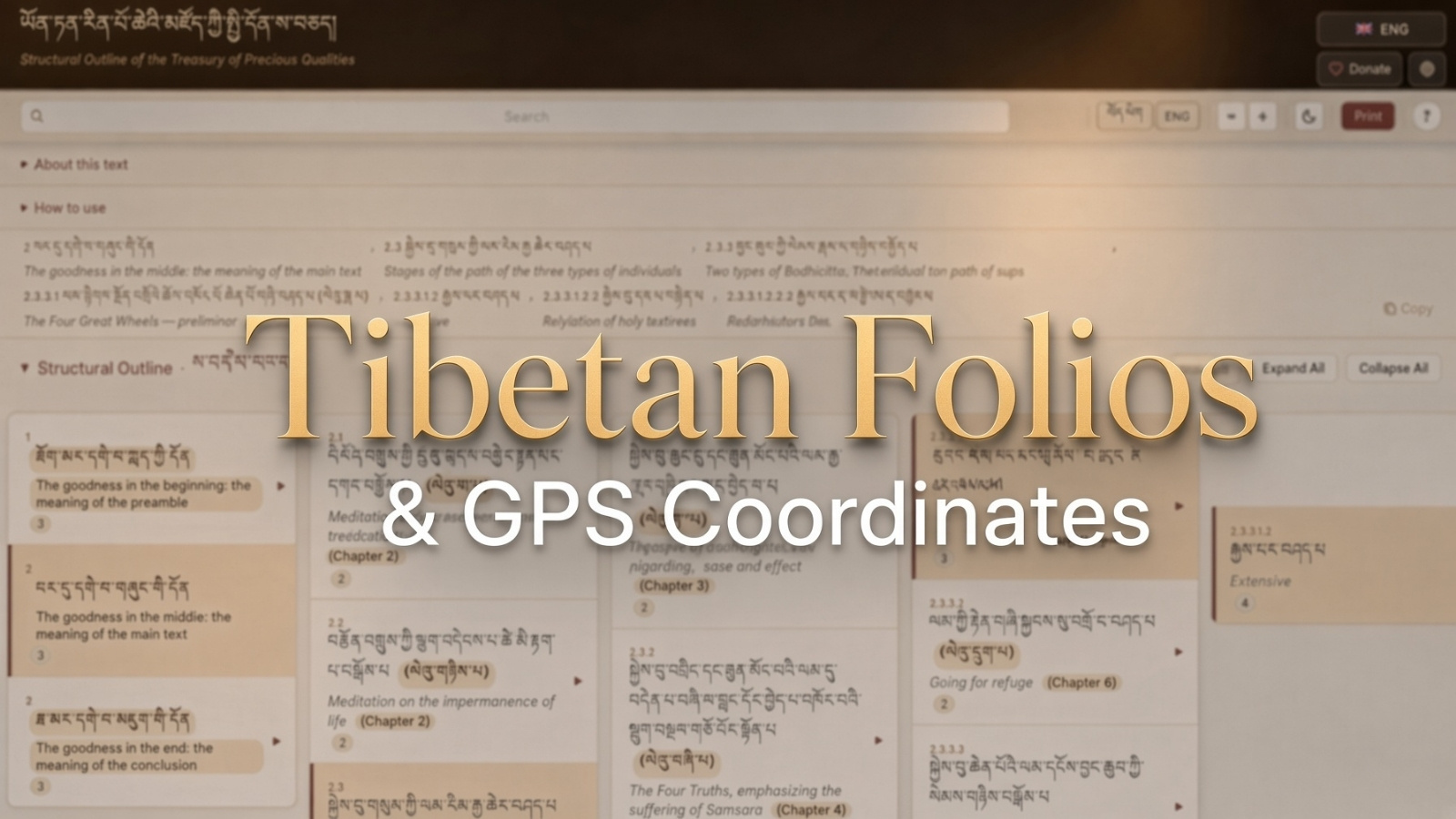
Tibetan folios and GPS coordinates
The Yönten Dzö Explorer and the overlooked role of the sa bche
Every class begins in roughly the same way.
Before proceeding with the next part of the text, the section of the sa bche already covered is recited.
This happens in traditional Shedra classrooms, and it also happens during the ongoing teachings on Jigme Lingpa's Yönten Dzö given by Khenpo Karma Wangyel, that have been ongoing for the past several years.
At first, a sa bche can look rather dry. Numbers, headings, subdivisions, then subdivisions within subdivisions. For students used to reading books from one paragraph to the next, it can resemble an elaborate table of contents (and is even sometimes erroneously translated as such).
In the traditional system of study it has a much more serious function.
It is the map that keeps the Root Text and Commentary connected.
That is the reason I built the Yönten Dzö Explorer.
Three texts
The teaching revolves around two separate works.
The first is Jigme Lingpa's Root Text, the Yönten Dzö, or Treasury of Precious Qualities.
The second is Khenpo Yönga Yönten Gyatso's Commentary, which explains Jigme Lingpa's verses in great detail.
The third (unseen to the students so far) one is what connects them: Patrul Rinpoche's Structural Outline, the sa bche. It maps the relationship between them and shows where every topic belongs within the work as a whole.
The Tibetan terms are worth knowing:
- gzhung — Root Text
- 'grel pa — Commentary
- sa bche — Structural Outline
The three work together particularly well because the first two operate at very different scales.
Jigme Lingpa's verses are highly compressed. A few words can contain the seed of a very extensive explanation. The form is mnemonic, economical and often cryptic when read without commentary.
Khenpo Yönga's Commentary opens those verses up. A single line may lead into definitions, quotations, philosophical distinctions, classifications, practical instructions and a chain of further subdivisions.
The sa bche sits between those two scales and keeps track of the relationship.
A coordinate system for a commentary
A sa bche (ས་བཅད།), literally "division of ground," divides a text hierarchically.
A major topic contains several smaller topics. Those may contain further divisions, which may divide again.
A path can eventually look something like:
2.3.3.3.1.2
At first this resembles bureaucratic numbering.
After working with the text for a while, it begins to behave more like a GPS coordinate.
The sequence tells you exactly where the present subject sits. Each number refers back to a larger division containing it.
The closest comparison I know is a computer directory:
folder > subfolder > subfolder > file
Anyone accustomed to programming or working with hierarchical data will recognise the logic immediately.
A sa bche is remarkably close to a computer-perfect system for keeping track of an elaborate file system. Every topic has a parent. Many topics have children. Every topic has a unique path.
This system existed centuries before computers, of course.
Why memorise an outline?
In a Shedra, the outline is often memorised.
That may seem like an unnecessary burden until one sees what it does to the way a text is understood.
A student who knows the sa bche hears a topic together with its location.
A teacher begins explaining a passage, and the larger hierarchy is already present in the student's mind.
This point belongs inside that section.
That section belongs within a larger division.
Those are the words of the Root Text currently being explained.
This is what preceded them.
This is where the commentary is heading next.
The outline gradually becomes a mental skeleton for the entire work.
This is especially valuable with a text such as the Yönten Dzö, where the root verses are compressed and the Commentary is extensive.
Without the structure, one can easily understand a great many individual explanations while slowly losing the thread connecting them.
What tends to happen in the West
Western students now have access to an astonishing amount of material.
We have translations, searchable Tibetan texts, recordings, transcripts, PDFs, digital dictionaries and online teachings that would have been almost unimaginable a generation ago.
The material is abundant.
The structural memory is often much weaker.
You may remember a very good explanation from a teaching but no longer remember exactly which line of the Root Text it belonged to.
You may read a verse and vaguely remember that it received several hours of commentary.
You may search through recordings or transcripts using a keyword because the location in the larger argument has disappeared from memory. This lack of context is becoming more and more alarming.
A Shedra-trained scholar traditionally solves much of this by internalising the sa bche.
I had not internalised Patrul Rinpoche's complete outline, but I became fascinated by it and its form.
I had a laptop. (And a Claude Code subscription)
That became the starting point for the app.
Why I built it
For several years I have been interpreting the ongoing teachings of Khenpo Karma Wangyel on the Yönten Dzö, organised by Yeshe Khorlo Germany.
Khenpo is teaching Khenpo Yönten Gyatso's Commentary on Jigme Lingpa's Root Text.
The first cycle dealt with the Sūtrayāna section. In 2025 we began the Vajrayāna cycle.
While interpreting, one has to keep several things in view at once.
There is the sentence currently being spoken.
There is the terminology.
There is the Tibetan Root Text.
There is the translation.
There is the Commentary.
And somewhere behind all of that sits the question:
Where exactly are we?
Which section?
Which subdivision?
Which verse?
Which branch of the outline exactly?
At some point I began building the tool I wanted to have open beside me.
The first requirement was very simple. I wanted to be able to see the hierarchy instantly.
The second was to connect that hierarchy directly with Jigme Lingpa's verses.
The project gradually became the Yönten Dzö Explorer.
In the process, I think a system was born, that can be used for other similar pairs of root text and commentary.
Making the sa bche visible
The standard view is a Tree.
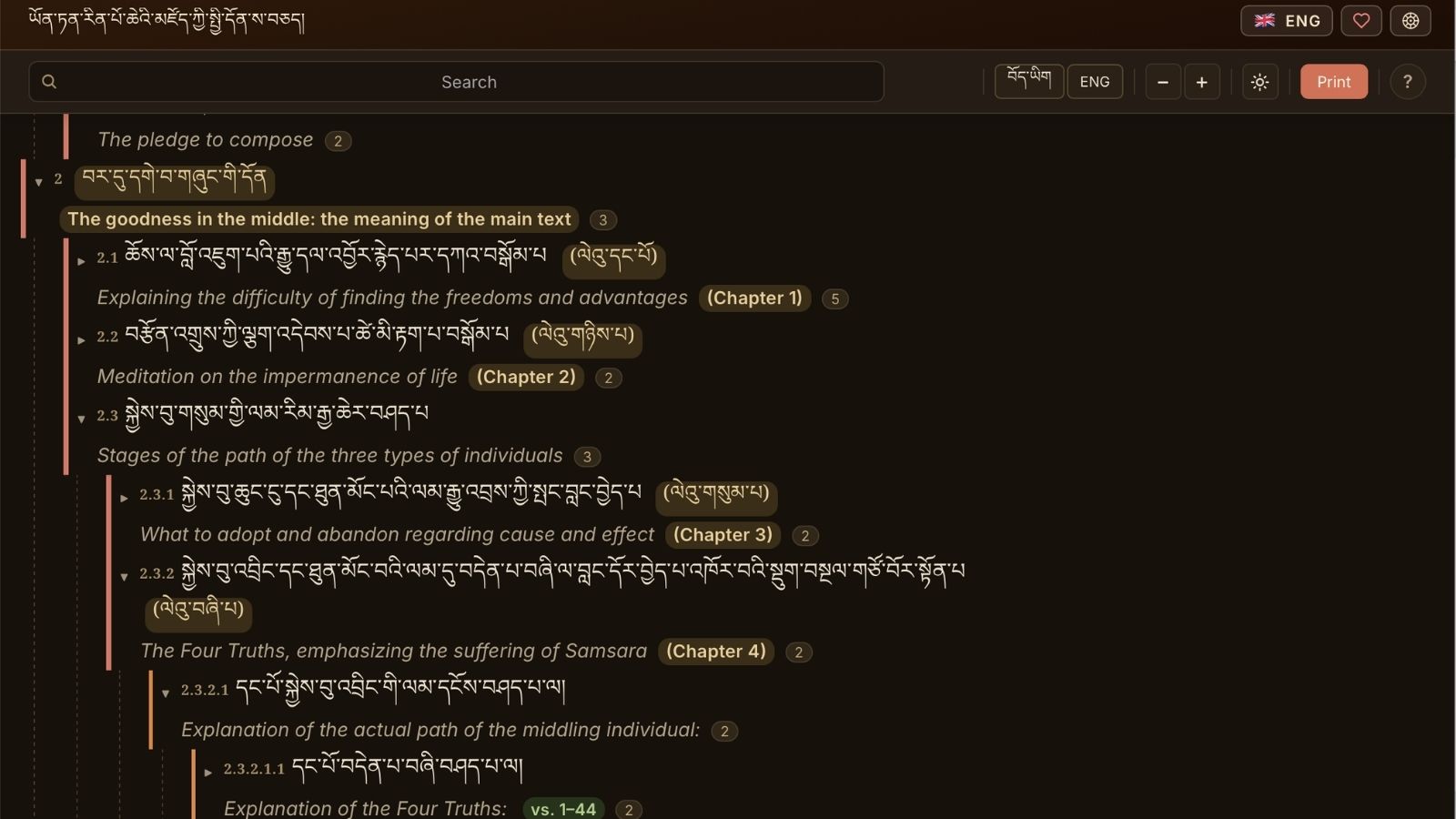
Every section appears beneath the subject containing it. Indentation shows the parent and child relationship, while colours change as the structure becomes deeper.
This makes the hierarchy visible immediately.
A section can be opened, then one of its subdivisions, then one of those subdivisions.
Only the branch being studied needs to remain expanded.
The structure remains available without filling the entire screen.
Miller columns
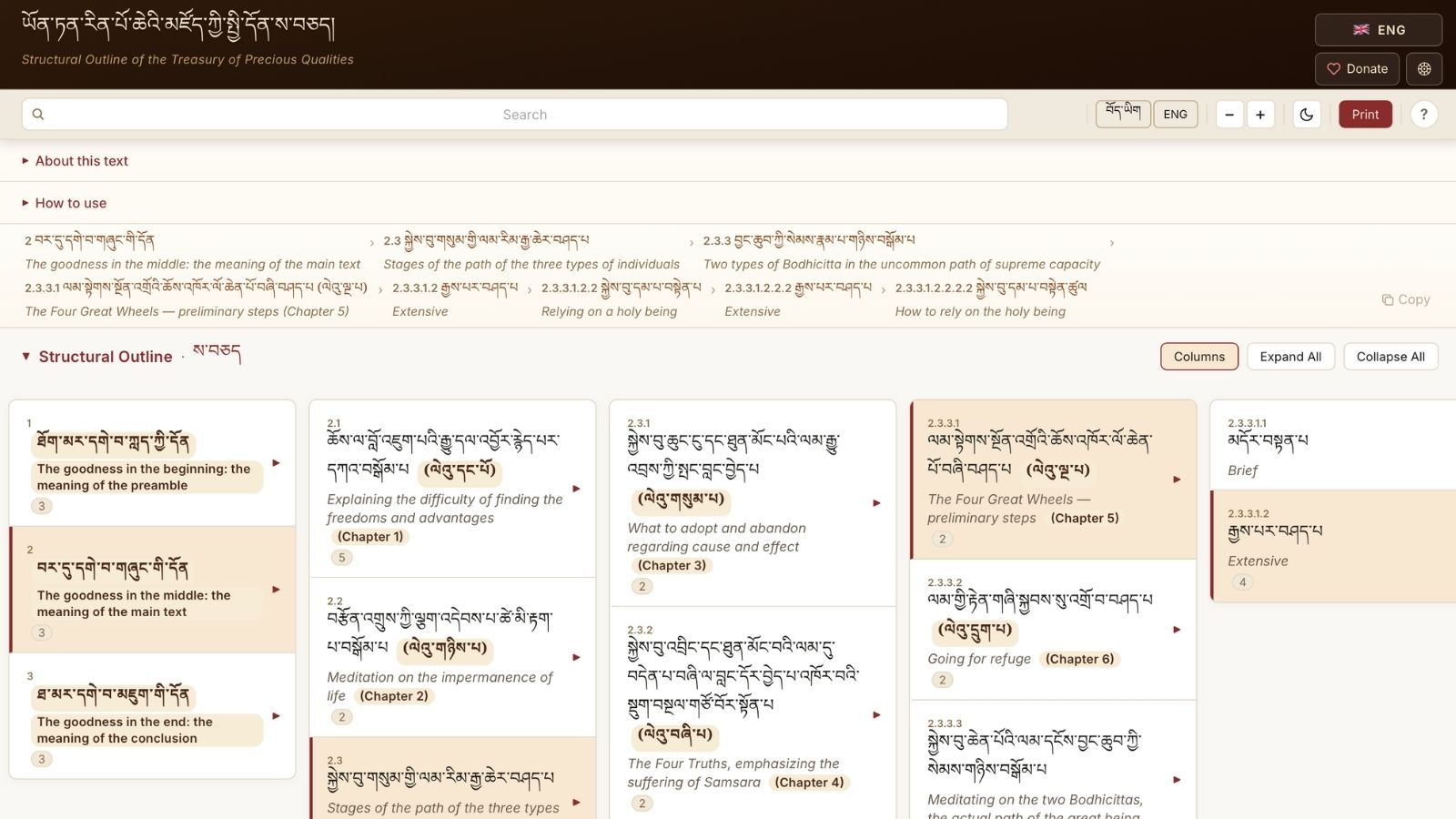
The second view uses Miller columns, the cascading folder display familiar from the macOS Finder.
Choose one subject and its children appear in the next column.
Choose one of those and another level appears beside it.
For the deeply nested sections of Patrul Rinpoche's outline, this becomes particularly useful.
It also makes the similarity between the sa bche and a filesystem very plainly obvious.
The traditional system already contains the parent-child relationships, hierarchical paths and nested levels.
The interface merely displays them.
The Mandala Explorer
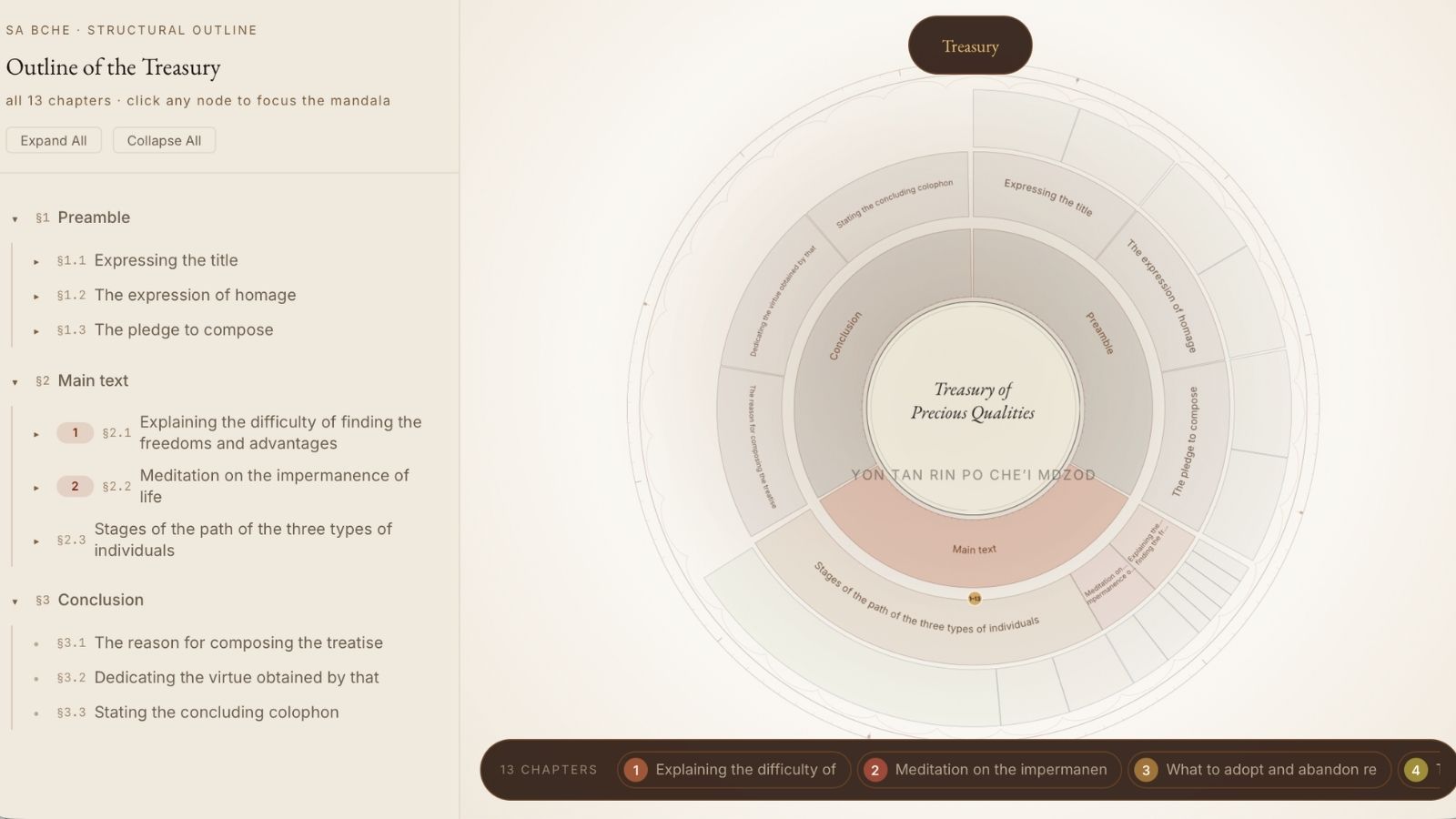
The third view is more experimental.
The Mandala Explorer presents the same outline spatially.
You enter a node and see the subjects contained within it. Selecting one takes you deeper into another level.
The name comes from the experience of progressively entering an organised space.
Patrul Rinpoche's outline itself remains unchanged.
I wanted to see whether a hierarchy normally represented through indentation could also be grasped spatially in a shape of a mandala.
The result is more playful than the Tree or Columns views, but sometimes a different visual form makes a complex structure easier to remember. It might be the hardest to navigate, but for some — it will be the most interesting one to explore.
Connecting Patrul Rinpoche to Jigme Lingpa
The most useful part of the explorer is the direct connection between the Structural Outline and the Root Text.
A section of Patrul Rinpoche's sa bche will contain a reference quoting the first few words of a verse. Here we added numbers, like vs. 45–47.
Tap it and Jigme Lingpa's Root Text opens at those exact verses.
The complete range is subtly highlighted.
The connection works the other way as well.
Tap a verse in the Root Text and the app takes you directly to the section of the sa bche associated with it.
This gives the student a continuous path between:
- Jigme Lingpa's words
- The commentary's structural location
While Khenpo Karma Wangyel teaches Khenpo Yönga's Commentary, the third element is supplied by the teaching itself.
The relationship becomes:
- Jigme Lingpa — what is being explained
- Patrul Rinpoche — where the explanation belongs
- Khenpo Yönga — the Commentary being unfolded
- Khenpo Karma Wangyel — the teacher transmitting and explaining that Commentary
This is the basic idea behind the app.
Keeping your place
Several smaller functions grew out of the same problem.
The breadcrumb trail shows the complete path from the largest division down to the topic currently selected.
The reading-position bar keeps the corresponding sa bche section visible while scrolling through the Root Text.
Search works across Tibetan, English, translated headings and structural numbers.
Cross-references can open cited passages from other works such as Nāgārjuna's Letter to a Friend without losing the current location (displayed in a slightly different colour).
The outline can also be printed exactly as expanded. This makes it possible to produce a focused study sheet for one section or a recitation sheet for use before a teaching. Printing doesn't mean you have to physically print the text on a sheet of paper — the function also creates a PDF file.
These functions are less spectacular than the graphical views, but they may be more useful during actual study.
The Commentary
The app contains Jigme Lingpa's Root Text and Patrul Rinpoche's Structural Outline.
Khenpo Yönga's Commentary is taught by Khenpo Karma Wangyel in the ongoing programme.
Keeping the Commentary within the teaching context was a conscious choice from the beginning. The explorer has a very specific role: keeping the text and its structure visible while the Commentary is being explained.
Students following the teaching can use it live.
Someone returning to a recording months later can use it in the same way.
The app provides the coordinates.
The teaching provides the Commentary.
Transmission
The Yönten Dzö eventually enters Secret Mantra Vajrayāna and Dzogchen.
These sections traditionally require the appropriate transmission, including the reading transmission (lung) and, where applicable, empowerment (wang).
The app therefore begins with a short reminder concerning transmission.
Students wishing to follow Khenpo Yönga's Commentary can join the ongoing teachings with Khenpo Karma Wangyel, organised by Yeshe Khorlo Germany.
Join the Yönten Dzö teachings by contacting Yeshe Khorlo Germany here: kontakt@yeshekhorlo.de
An old system that fits a computer unusually well
One of the things that became apparent while building the explorer was how naturally Patrul Rinpoche's outline translated into software.
Very little conceptual adaptation was required; the hierarchy was already present, and clear.
The parent and child relationships were already there, albeit hidden within terse Tibetan, often with the use of abbreviations, but every topic already had a clear path.
The entire structure was already designed to allow someone to move between a specific detail and the larger argument containing it.
The computer adds visibility, search, instant navigation and links between the outline and Root Text.
The underlying information architecture comes from the traditional system itself.
What is supplied is a digital way to connect the dots, forming a shape that would otherwise be clear (like in the mind of expert Tibetan scholars), if it wasn't for the overwhelming amount of white noise our minds tend to contain.
Digital editions of traditional texts often concentrate on making the words searchable and portable. The sa bche points to another possibility. Some of the older methods of organising knowledge are themselves extremely well suited to a digital environment.
The Yönten Dzö Explorer grew from that observation and from a very practical need during the teachings.
I hope it proves useful to others studying the text for the same reason I first needed it:
to know, at any given moment, exactly where they are.
Yönten Dzö Explorer
https://donandrutto.github.io/Yontendzo/
Ongoing teachings with Khenpo Karma Wangyel
Yeshe Khorlo Germany's email: kontakt@yeshekhorlo.de
Register here
Developed by Andrzej R. Rybszleger, 2026
translation@arybszleger.com